
BLOG
AI Tools to Boost Developer Efficiency: Insights from TAI AMA #05 at Code Chrysalis
Introduction
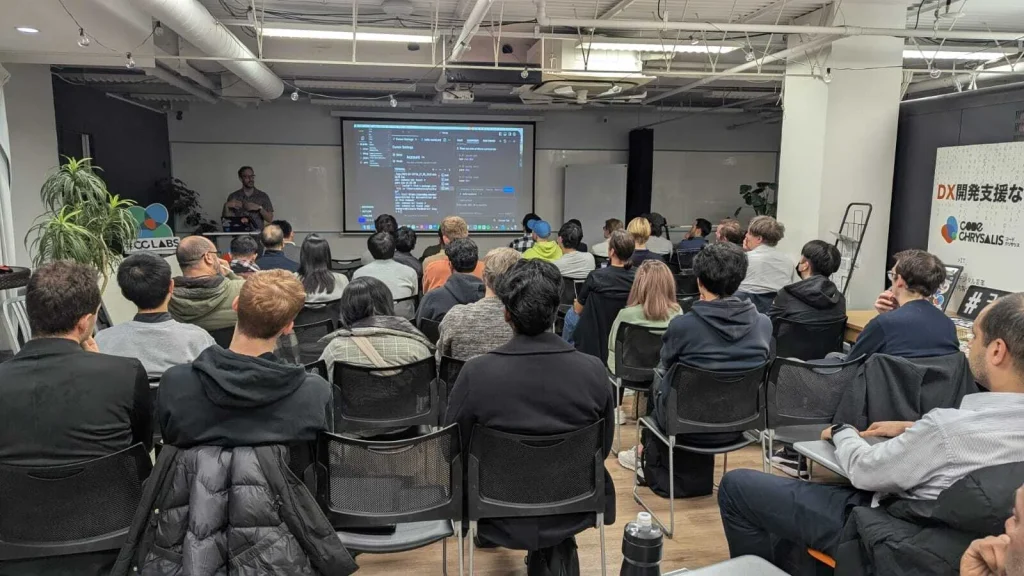
AI is transforming software development by automating repetitive tasks, improving code quality, and making developers more efficient. On February 18th, Tokyo AI (TAI) hosted TAI AMA #05: AI Tools to Boost Developer Efficiency at Code Chrysalis, a premier coding bootcamp in Tokyo. Led by Michael Makarov (@micmakarov) (ex-Google, ex-Twitter, now at Pinecone), the session explored how AI tools like Cursor can supercharge developers’ productivity.
The event featured a live coding demonstration, expert insights, and hands-on applications of AI tools in real-world workflows. With participation from engineers eager to integrate AI into their development processes, this session provided a fresh perspective on AI-assisted coding.
Why AI Tools Matter in Software Development
AI has become a fundamental part of modern software engineering, helping developers work faster and smarter. Instead of replacing engineers, AI serves as an augmentation tool, enabling developers to focus on higher-level problem-solving while it handles boilerplate code, debugging, and optimization.
Industry leaders have acknowledged this shift:
- Jeff Dean (Google AI): AI can help us write better software, faster, but I don’t think AI will replace programmers. [Source]
- Sundar Pichai (Google CEO): Over 25% of Google’s code is written by AI. [Source]
- Mark Zuckerberg (Meta CEO): By 2025, AI will be capable of performing mid-level engineering work. [Source]
A key study from GitHub Copilot found that developers using AI-assisted coding tools were 55% faster than those coding manually. Cursor, as a more advanced AI-powered editor, aims to push efficiency even further.
What is Cursor?
Cursor is an LLM-wrapped environment designed for managing codebases, integrating AI-powered development tools to streamline workflows. It combines code completion, refactoring, debugging, and rule-based automation into a single interface, helping developers write, organize, and optimize code more efficiently. By embedding AI directly into the development process, Cursor enhances productivity and accelerates coding tasks, making it an essential tool for modern software engineers.
Cursor: A Game-Changer for Developers
One of the event’s key highlights was Cursor, an AI-powered code editor that functions as an AI-enhanced development environment, allowing developers to write and manage code more efficiently.
Cursor Features
- AI-powered code completion – Similar to GitHub Copilot but with additional workflow automation.
- Smart error detection & debugging – AI suggests fixes and helps troubleshoot problems.
- Code refactoring & optimization – AI assists in restructuring code to improve maintainability.
- Rule-based automation – Users can create project-specific rules to guide AI behavior (e.g., defining where components should be stored).
- Integration with latest documentation – Cursor indexes and vectorizes updated docs to ensure AI references the correct information.
How Cursor Improves Efficiency
According to a survey conducted at the event:
- 67% of attendees had never used Cursor before.
- 90% were curious about its capabilities.
- 12% were already using it regularly.
Michael Makarov demonstrated how Cursor could potentially make developers up to 80% faster, leveraging AI’s ability to automate repetitive tasks. With GitHub Copilot already providing a 55% speed boost, Cursor’s additional features aim to push efficiency even further.
Live Demo: AI-Powered Blog Generation
A key part of the session was a live demo showcasing Cursor’s capabilities. Michael walked the audience through building a blog using AI, demonstrating:
- Automated project setup – Creating a Next.js project using AI commands.
- Content generation – AI-generated blog posts summarizing event highlights.
- AI-assisted debugging – Fixing errors in real-time using Cursor.
- Enhancing UI/UX – Using AI-powered design suggestions for a cleaner, modern blog.
While the demo successfully showcased AI’s potential, some parts didn’t go smoothly due to the non-deterministic nature of AI-generated code. Cursor occasionally produced unexpected output that wasn’t structured as intended, requiring manual intervention. Prompt variability led to inconsistent results, emphasizing the need for well-crafted prompts to ensure predictable behavior. Additionally, the tool sometimes attempted to use outdated dependencies, reinforcing the importance of human oversight in AI-assisted development. Despite these challenges, the session highlighted that AI, when used effectively, remains a powerful augmentation tool for developers.
Key Takeaways
- AI is an Augmentation Tool for Developers
Rather than replacing engineers, AI serves as a powerful assistant, handling repetitive coding tasks and allowing developers to focus on problem-solving and architecture. - AI-Assisted Coding Can Make You Much Faster
Studies show that GitHub Copilot users are 55% faster, and Cursor aims to extend that efficiency even further with additional automation features. - Rule-Based AI Helps Maintain Code Consistency
One standout feature of Cursor is the ability to set project-specific rules, ensuring code organization remains consistent. Examples include:- Defining where UI components should be stored.
- Automatically updating README.md files when new features are added.
- Applying consistent styling and documentation practices.
- AI’s Non-Determinism Requires Human Oversight
AI tools can sometimes generate unpredictable results, meaning developers need to refine prompts and verify outputs. AI doesn’t eliminate work—it shifts the focus to higher-value problem-solving.
Questions from the audience
- Can Cursor automatically apply changes, or do they need to be reviewed manually?
Cursor allows users to choose whether AI-generated changes apply automatically or require manual approval. Some developers prefer full control, especially for critical infrastructure code, while others opt for automation to speed up workflows.
- Can AI tools like Cursor be used to train models like ChatGPT or Claude?
Yes, Cursor can index and retrieve external documentation and be used to fine-tune models with additional context. However, training a model from scratch requires a custom setup and additional infrastructure.
- Does Cursor allow users to opt out of data being used for training?
There was a discussion about whether Cursor collects user data for model training. Some attendees recalled being asked about data permissions during installation, but it was suggested that enterprise users have stricter compliance options.
- How does Cursor handle updating indexed documentation?
When documentation changes, Cursor does not update automatically unless re-indexing is triggered manually. This was noted as a potential limitation, as some APIs update frequently.
- How does Cursor compare to other AI-powered coding tools?
An audience member asked about emerging alternatives to Cursor, such as ByteDance’s AI-assisted development tool. The response highlighted that Cursor is currently the most widely used, but the AI tooling landscape evolves quickly, and developers must continuously evaluate the best tools for their workflow.
- How does AI-assisted code impact project costs?
Developers can use Cursor by paying a monthly subscription or connecting their own API keys to different LLMs. Using an external API incurs per-token costs, which can add up depending on the size of the codebase and frequency of queries.
These questions reflected developer concerns about AI reliability, cost, automation, and privacy, reinforcing that AI tools are powerful but require thoughtful integration into coding workflows.
Final Thoughts
If you’re a developer looking to boost efficiency, it’s time to embrace AI-powered tools like Cursor. Whether you’re working on solo projects or part of a large engineering team, AI can help automate mundane tasks, improve code quality, and accelerate development cycles.
Want to stay ahead in the AI-driven dev world? Join the next Tokyo AI event!
Follow Tokyo AI and Code Chrysalis for upcoming sessions.
お問い合わせ
CONTACT
サービスご利用についてのご相談や資料請求は
お問い合わせフォームよりご連絡ください。